Kalshi API Rate Limits and Request Throttling Strategies
Token buckets, not per-second caps, are where most throttling problems start.

Kalshi's rate-limit system runs on token buckets, not a flat per-second cap, so if you never map your request pattern to that structure, most throttling problems trace back to that gap. Once you understand how tokens get charged, which bucket absorbs which call, and how bursting works, the rest of a resilient integration follows from that foundation.
How Kalshi's token-bucket architecture works
Every authenticated call to Kalshi draws down a token balance, and the tier assigned to your account sets how fast that balance refills, measured in tokens per second. Most calls cost the default of 10 tokens, but not all of them do; the real list of exceptions lives at GET /account/endpoint_costs. That endpoint is the only reliable way to know what a given call actually costs you at any point in time.
Two separate buckets run independently of each other: a Read bucket covering GET endpoints and anything not explicitly routed to Write, and a Write bucket covering order placement, amends, cancels, order groups, the RFQ quote flow, and block trade proposal accepts. Draining one has no effect on the other, so a bot hammering market data through Read calls won't choke its own order placement through Write, at least not directly.
Predictions markets complicate this with per-shard Write buckets. If an order create or cancel targets a specific exchange shard, meaning exchange_index is set to 1 or higher, it draws from that shard's own Write bucket, and that bucket carries your full tier budget there too. That's a quiet cost multiplier for anyone who leans on auto-routing across multiple markets without realizing what it does to total consumption. Batch creates and cancels always bill the unscoped Write bucket no matter what exchange_index is set to, and RFQ and quote writes bill the shard 1 Write bucket specifically, sharing that pool with ordinary shard 1 order writes. (FIX users see the same logic through tag 100, ExDestination, which routes the same way.)
Basic and Advanced tier Predictions Read buckets, along with Write buckets above the Basic tier, can bank up to three seconds of unused budget during idle time, so if a client sits quiet and then fires a burst of calls, it can hit three times its per-second rate before getting throttled. Perps traffic has its own separate Read and Write buckets, so event-contract activity and perps activity never share one.
What 429s Tell You, and What They Leave Out
A 429 response from Kalshi carries almost no diagnostic information, so the retry logic has to be built entirely on assumptions you supply yourself. The response body reads {"error": "too many requests"}, full stop, with no Retry-After header and no X-RateLimit-* headers to tell you how long to wait or how close you were to the limit before you hit it.
Batch endpoints raise the stakes on this. The exchange checks whether the bucket can cover the full cost of the batch at the moment it arrives, and if it can't, the entire batch gets rejected. A batch of 25 order creates needs 250 tokens sitting ready at once; short that by even a few tokens and nothing goes through.
The failure mode that catches the most developers off guard is the ambiguous timeout. The only safe move is to reconcile by client reference before retrying, or to retry using the same ClOrdID so a duplicate order can't slip through. The FIX changelog for v1.0.30 added a distinction that helps here: EXCHANGE_UNAVAILABLE now marks an outcome as genuinely unconfirmed, separate from a definite reject, which gives integrators a clearer signal than they had before.
None of this is abstract when a position is open. Cancel requests and status checks draw from the same Write bucket as routine order placement, so a 429 that lands while you're holding a position can block the very calls you need to manage the risk on that position.
Why the shared-budget problem bites multi-worker bots hardest
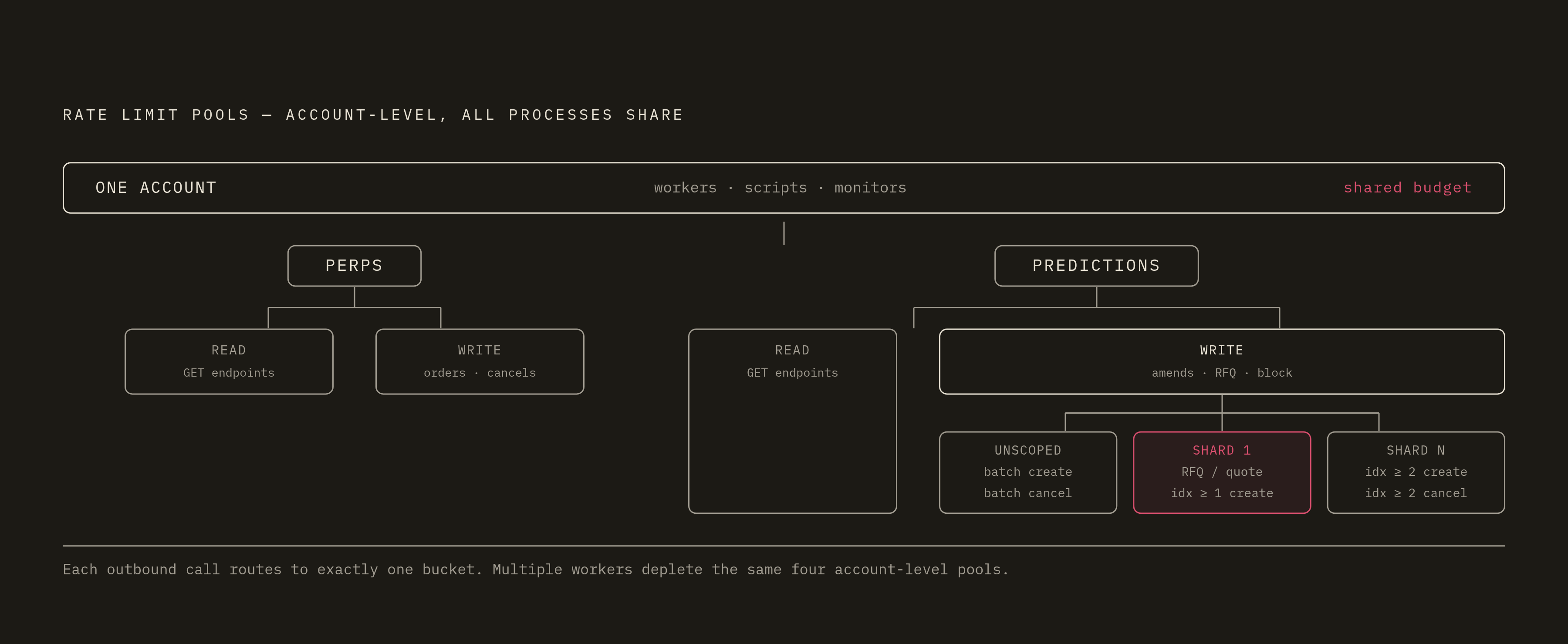
The token budget attaches to the account, not to any individual process, so every worker, script, and monitoring job sharing one set of credentials draws from the same pool, whether or not any of them know the others exist. Kalshi's system has no visibility into how many consumers are hitting it at once, and it doesn't need to: the budget is what it is, and dividing it up correctly is the integrator's job.
A Basic tier account gets 200 Read tokens per second against a 10-token default cost, so it can sustain only a modest number of reads per second, and every bot and script running under that account draws on that same allowance at once. A worker built on the assumption that it owns the full budget will, in combination with two or three siblings making the same assumption, exhaust that budget far faster than any one of them would alone. What follows is a wave of 429s that no single component can explain on its own, because none of them has visibility into what the others are doing.
Tier qualification tightens this bind. None of this reflects a flaw in how Kalshi built the system. It reflects a structural fact that any integrator running more than one process against a shared account has to design around deliberately, usually by centralizing control of that budget.
Replacing polling with WebSocket streaming as the primary rate-limit fix
The biggest single reduction in throttling risk doesn't come from smarter retry logic. It comes from cutting out most REST traffic, because you move market data onto a WebSocket connection instead.
Polling an orderbook on a fixed interval across a list of tickers racks up a steady stream of REST reads, continuously drawing against Read budget whether or not the market actually moved between checks. A WebSocket subscription to orderbook_delta replaces that pattern entirely: after an initial orderbook_snapshot establishes the starting state, every subsequent update arrives incrementally over the same persistent connection, at no additional token cost. The polling volume that pattern replaces can run into the hundreds of REST calls per cycle for a bot watching several markets at once.
Once WebSocket handles live book and trade monitoring, REST gets reserved for the calls that actually require authentication and have consequences, meaning order placement, cancels, balance checks, and reconciliation. That shift alone can take a bot from hundreds of REST calls per cycle down to a handful. Kalshi does cap orderbook WebSocket subscriptions, limiting how many markets a single session can subscribe to and how many commands it can send per second, but those ceilings only matter at the scale of RL training environments running many parallel agents, not for a typical trading bot watching a reasonable set of markets.
WebSocket connections authenticate during the handshake, and a reconnect has to rebuild subscription state before the bot resumes acting on it. A reconnect that doesn't resubscribe properly leaves the bot making decisions on stale data, which defeats the purpose of moving to streaming.
Backoff, staggering, and centralized queuing for the REST calls that remain
WebSocket streaming takes market data off the Read budget, but the REST calls that remain, meaning orders, cancels, and reconciliation, still need careful handling, particularly when several of them land in a short window.
Exponential backoff with jitter is the standard response to a 429. The jitter matters as much as the backoff itself. Without some randomness added to each wait, multiple workers that all got throttled at once will retry in lockstep, recreating the exact burst that triggered the 429. The same retry wrapper should treat 5xx server errors the same way it treats 429s, because to the calling client a transient server failure and a rate limit look alike, and both call for the same cautious response. And because Kalshi's 429 carries no Retry-After header, every backoff interval is a guess rather than a known quantity, so a more conservative guess costs less than an aggressive one when there's an open position on the line.
Staggering handles the case of a strategy watching many markets at once. Firing calls sequentially with a small delay between each, rather than launching them all in parallel, keeps a full scan across a large ticker list completing in a matter of seconds, well inside the update cadence of most strategies. That discipline keeps average token consumption comfortably below the sustained limit even during a heavy scan window, so burst capacity stays free for the order actions that need it.
Running one token-bucket limiter in front of the shared account, instead of letting each worker manage its own imagined full allowance, is the only way to honor a budget that's actually shared across every process touching that account. Pair that with caching for metadata that rarely changes, such as ticker symbols, contract thresholds, or settlement dates, using a reasonable TTL. Instrumenting every 429 and every retry delay matters too: when risk-critical Write traffic like cancels and status checks is visibly competing with background Read traffic for the same budget, the architecture needs to split those concerns into separate, prioritized paths, each weighted according to how critical its requests are.
The legacy endpoint penalty and V2 migration as a throttling concern
Staying on the legacy /portfolio/orders mutation and batch endpoints is no longer a simple maintenance item you can clean up eventually. Those endpoints now consume Write budget at a sharply higher rate than their V2 equivalents, so a bot still routed through them burns through its allowance faster than its request volume would suggest.
Checking both isn't optional diligence; it's the only way to know the migration worked as intended.
The pace of change elsewhere in the API underscores why migration and ongoing monitoring both matter. None of these individual removals demands a long explanation on its own. Taken together, they show an API surface that moves too fast for a one-time migration, so checking endpoint costs and tier limits needs to be a recurring habit, not a box checked once.
Testing rate-limit handling without touching live credentials or burning budget
Throttling logic, backoff behavior, and the coordination problems that come with multiple workers are among the hardest things to test reliably, whether you use the live API or Kalshi's demo environment. If a test suite places real orders to verify retry logic, it burns real Write budget, it risks leaving open positions on the books, and it still can't reliably reproduce a 429 on command. Kalshi's demo environment solves part of that problem: it runs on separate credentials from production and gives developers a safe space to test order flow. But it doesn't offer controllable fault injection, so there's no way to tell the demo API to return a 429 at a specific moment and confirm the backoff path actually works.
A stateful simulator closes that gap. Placing an order, listing it, and canceling it needs to update a persistent world state the same way the real exchange does, because a backoff wrapper only proves itself when it's retrying a call that actually changes something, not when it's hitting an isolated stub that returns the same response every time. Fault injection, covering 429s, 503s, latency spikes, and mid-request timeouts, lets a developer verify the ambiguous-timeout reconciliation path, confirm centralized-queue behavior under a simulated burst, and check that cancel traffic correctly takes priority over routine scan traffic, all without spending a cent of live rate-limit budget or touching production credentials.
Rystic's Kalshi simulator is built around that exact need. It runs locally, holds state across calls the way a real exchange does, ships with pre-seeded realistic data, and supports controllable fault injection, and Kalshi checks it against the real API before every release so its behavior doesn't quietly drift from what production actually does. If hundreds or thousands of containers need to watch many markets simultaneously for RL environments and agent testing at scale, live API rate limits make that kind of parallelism impossible to run safely against the real exchange, so a deterministic stateful simulator that can scale horizontally is close to the only practical option.
Automatic tier qualification and the 2026 upgrade path
Automated tier qualification, which went live on June 11, 2026, took the manual bottleneck out of the upgrade path: Premier, Paragon, and Prime tiers are now earned automatically based on trailing trading volume, with Kalshi retaining the ability to grant them manually as well. Predictions Read and Write rate limits for Premier, Paragon, Prime, and Prestige also increased in 2026, widening the gap between what those tiers offer and what Basic provides.
The underlying tension hasn't gone away, but automation makes it easier for you to manage. A Basic-tier developer works with 100 Write tokens per second and no burst banking on that Write bucket, so you need to generate enough trading volume to qualify for Advanced and the tiers beyond it. But generating that volume safely requires exactly the rate-limit headroom that only the higher tiers provide, a circular dependency that no amount of automation removes on its own.
The combination of strategies covered here is what actually resolves that bind. WebSocket streaming takes market-data polling off the Read budget entirely, V2 migration recovers the budget lost to the legacy endpoint penalty, staggering and caching keep average consumption well under the sustained limit even during active periods, and if you test throttling logic against a stateful local simulator, stress-testing happens before a strategy starts generating the volume that production trading requires. Watching GET /trade-api/v2/account/limits on an ongoing basis closes the loop, since it's the one place that shows, in real time, whether an account's tier grant has actually kept pace with the trading it's doing.