Structured Correctness Evidence Serious Quants Compile for a Kalshi Bot Before First Live Order
A Kalshi bot needs separate proof for strategy, exchange, risk, and resilience.

Before a Kalshi bot places its first live order, it needs separate evidence that its strategy logic, exchange integration, risk controls, and operational resilience work. A backtest cannot establish correctness across those boundaries. A structured evidence dossier records what each test proves, which assumptions it depends on, and what remains untested before production trading begins.
Why each layer of a Kalshi bot carries its own distinct failure mode
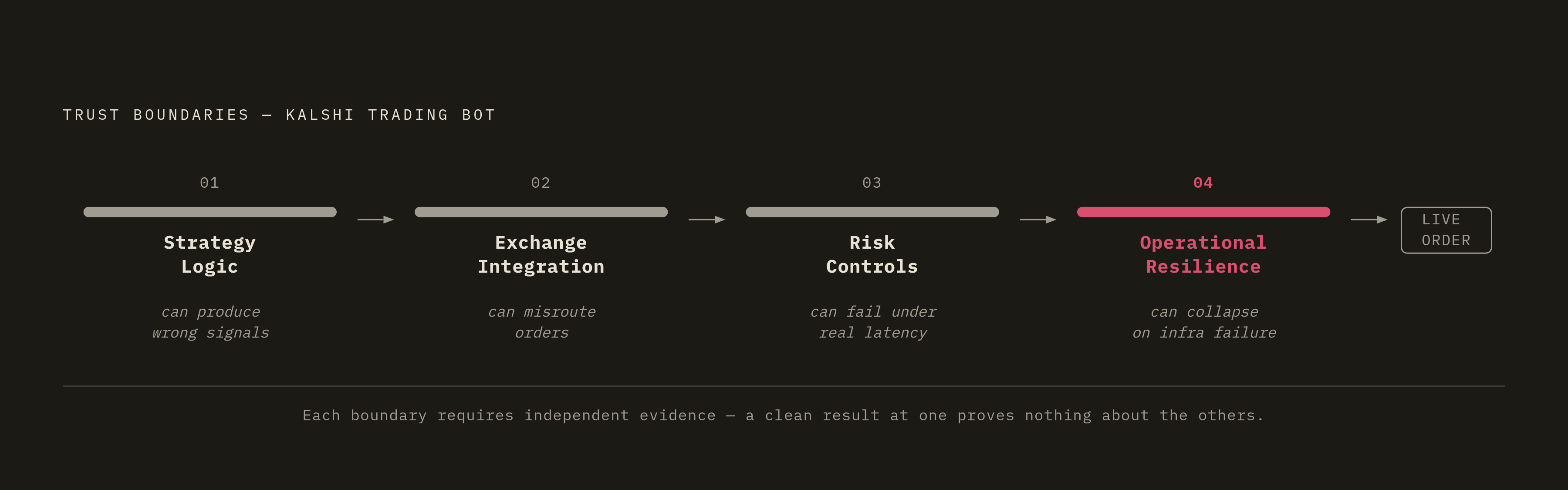
An automated trading system crosses distinct trust boundaries as a decision becomes an exchange order. Strategy logic determines the intended action, exchange integration communicates it, risk controls constrain it, and operational resilience governs behavior when infrastructure fails. These boundaries require independent evidence. A strategy that backtests cleanly can still misroute orders, while an integration that authenticates correctly can still mishandle partial fills. Risk controls that work in isolation can fail to halt a runaway bot under real latency.
Correctness is therefore not a single yes-or-no property. Treating it that way allows a successful test at one boundary to stand in for missing evidence at another. For a Kalshi bot, the practical consequence is a partially verified system presented as ready for live trading. The dossier must prevent that substitution by attaching every result to the boundary it actually tests.
How do you backtest a Kalshi strategy before it touches an exchange?
Evidence for the strategy layer must come from tests that are kept fully separate from the exchange and use no live API calls or demo credentials. Its starting point is an explicit account of the data window, source, coverage, and any survivorship or look-ahead bias. Assumptions belong beside results in the record. The fill model must also explain spread and slippage assumptions because modeled paper results cannot reproduce live queue position, latency, partial fills, rejection, or slippage.
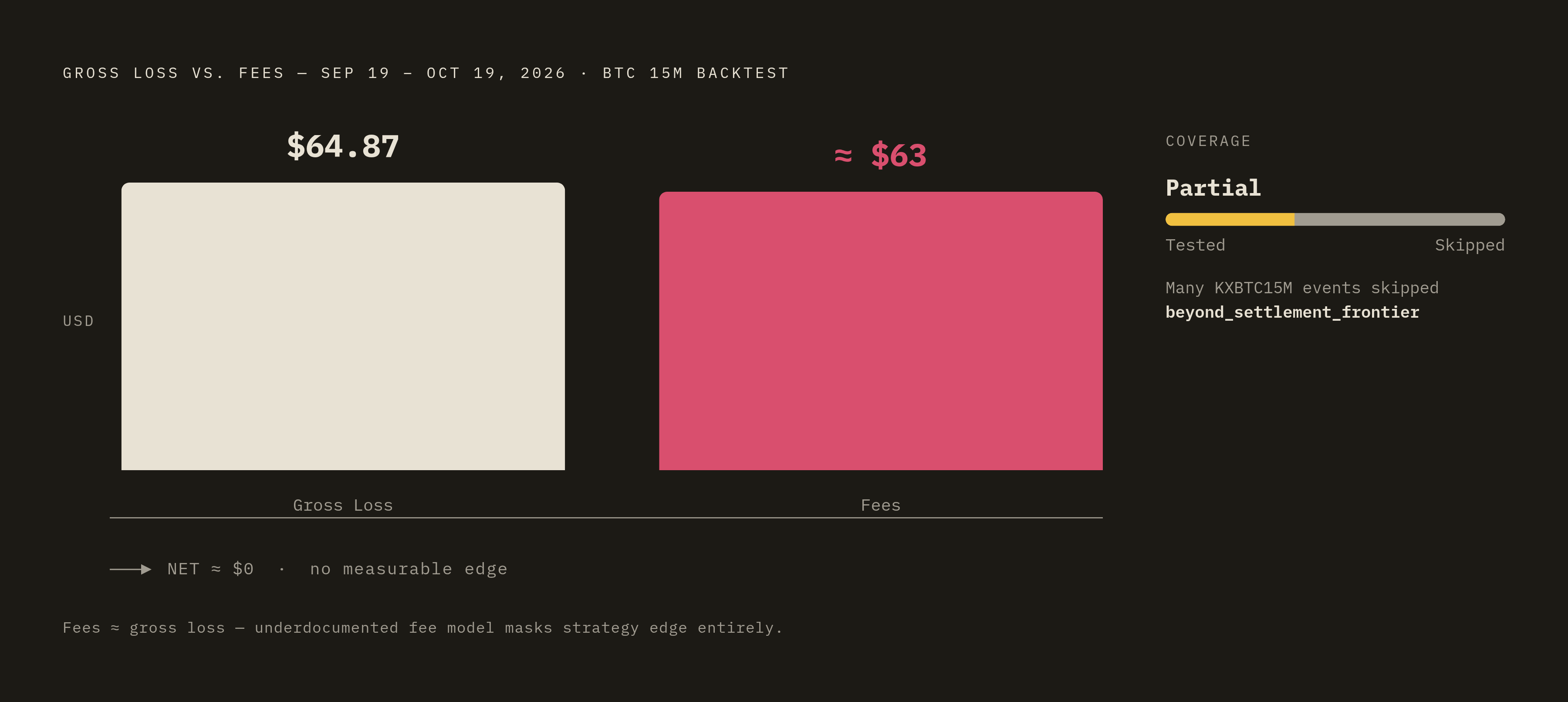
Turbine’s September 19–October 19, 2026 BTC 15-minute backtest provides a concrete example of why coverage needs its own evidence. The run covered only a portion of KXBTC15M events in the 30-day window, with a large share skipped for the logged reason beyond_settlement_frontier. The run manifest explicitly flagged that partial coverage. That disclosure lets a reviewer distinguish the named date range from the events actually tested, rather than assuming that every event in the window contributed to the result.
The same run recorded fees nearly equal to its gross loss of $64.87. An underdocumented fee model can therefore obscure whether a strategy has any edge at all, making gross result, fees, and net result separate requirements in the record. This is evidence about the modeled strategy. Even a complete manifest cannot show whether orders reach the exchange correctly, risk controls fire on time, or the bot recovers from an infrastructure fault.
How the demo environment tests exchange integration without touching production
Kalshi’s demo environment addresses the next boundary by testing exchange interaction without production orders. A complete cycle exercises authentication, market fetching, order placement, cancellation, fill and position reading, and WebSocket reconnection. Authentication alone is only the opening test. The remaining operations establish whether the bot can follow an order beyond submission and maintain its connection to exchange state.
Demo credentials are separate from production, and a demo API key is created at demo.kalshi.co under account settings. Kalshi’s official API Environments page recommends external-api.demo.kalshi.co/trade-api/v2 as the demo API root. Going live involves a base-URL swap and the production key, so the recorded host URL and credential separation make clear which environment a result describes.
Runtime compatibility also belongs to this layer. Ubuntu 24.04 comes with Python 3.12, which can use modern versions of the cryptography library for Ed25519 signing. An environment-specific signing compatibility failure would occur during integration testing. The dossier therefore needs the SDK version as well as the session results. Even when a demo cycle succeeds, it cannot show what liquidity or profitability will be in production, or how well the bot will hold up under real infrastructure faults.
Why stateful test coverage is non-negotiable for order-lifecycle correctness
Order-lifecycle correctness depends on history because the response to a later API call depends on what an earlier call did. Consider a sequence that creates an order, receives a 201 with an order ID, polls that ID until completion, then attempts cancellation and receives a 409 because the order already completed. Depending on the fixture, polling either never terminates or terminates immediately, identifiers may not match, and the completion-dependent conflict path remains untested.
Kalshi-specific transitions make the need for state equally clear. An order that is placed, partially filled, and then expired at market close passes through three states. Order group cancellation requires more than an individual order’s status. When filled contracts in a rolling 15-second window exceed the configured limit, every resting order in the group is canceled, so a useful simulation must track group membership and accumulated fills across calls.
The available tools serve different testing roles. Prism is OpenAPI-driven and stateless, while WireMock supports handwritten stubs, stateful scenarios, and real fault injection. Mockoon is visual with limited state, MSW handles in-process JavaScript, and Microcks is self-hosted and imports API definitions.
A stateful simulator with pre-seeded data can exercise the full lifecycle in CI without demo credentials, provided its behavior is verified against the real API before each release. That does not make every test stateful. The majority should remain stateless, with stateful coverage reserved for complex workflows. Stateful tests need their own isolated data and must run one at a time, and the suite must work in random order without relying on which tests happened to run before.
The sandbox drift problem and how to detect when a simulator has fallen out of sync with the real API
A simulator can represent state correctly and still represent the wrong API behavior. New response fields, divergent rate limiting, and subtle webhook payload changes can leave a sandbox behind production. Passing tests then reflect an inaccurate model of the dependency. This problem applies to any third-party API the bot uses, including Kalshi and internal mocks built against an older specification.
Verification requires three complementary signals rather than one authoritative-looking document. A Tolerant Reader client parses only the fields the bot uses, so added production fields do not break it. Spec diffing tracks declared additions, removals, and type changes in the published OpenAPI definition. Runtime contract checks against the live API address undocumented drift. The specification describes the contract, but actual responses reveal whether the dependency follows it.
A CI job can upload an api-receipt.json artifact even when the check fails, with machine-readable categories such as fixture_unavailable, transport_timeout, and contract_mismatch. Those distinctions make trends visible without weakening a contract check merely because a test account expired. They also separate unavailable evidence from evidence of a genuine mismatch.
The ryanfrigo/kalshi-ai-trading-bot repository illustrates a useful separation between safe and live suites. Its safe suite needs no credentials and never touches the live API, while tests marked live call the real Kalshi API, may place real orders, and are skipped by default. Simulator fidelity scores serve a related documentation role when they report response agreement across specific endpoints and state transitions, giving reviewers an auditable scope.
What risk control evidence looks like and why it must be tested under adversarial conditions
Correct order routing does not establish correct risk enforcement. A control in the code shows what it is meant to do, while a test that triggers it on purpose shows whether it fires when it should. The dossier needs evidence for maximum price per order, maximum contract count per order and per day, and the daily loss limit. It also needs evidence for a unique client_order_id on every order and for configured order group cancellation. Each control requires its own demonstrated trigger.
Idempotency provides a particularly sharp test of that distinction. A network timeout after submission leaves the exchange state unknown because a missing response does not prove rejection. The minimum acceptable test drops the response after an order is accepted, then finds that order by client reference without duplication. Reconciliation must precede any retry. A test that simply retries after a timeout does not establish this property.
The fault catalog must cover valid and rejected authentication, duplicate signals, partial fills, stale signals, unavailable markets, post-submission timeouts, rate-limit responses, an exchange pause, alert delivery, and the kill switch. Production incident history provides a grounded way to derive these cases. Each previously untested fault class can become a deterministic injection test.
Turbine’s BTC 15-minute bot documentation shows why control scope must be explicit too. Its backtest used a maximum loss of 5.00 per market, whereas the live loss limit applies across all markets and would halt the bot much earlier. The dossier must document and test that difference separately from strategy performance.
How fault injection exposes resilience gaps that integration tests miss
Risk controls concern what the bot decides, while operational resilience concerns whether its infrastructure survives the conditions in which those decisions must be made. A bot can route orders and enforce limits when things run smoothly yet fail without warning under stress. Clean integration results cannot establish resilience under injected faults. The bot must pass those tests on the demo path before it moves to live trading.
AgentChaos’s August 2026 paper warns against trusting success as it appears on the surface. In tests of five agent architectures and 65 fault configurations, the faults that did the most damage returned a normal HTTP 200. These were silent semantic failures, and diagnosis tools caught them only a small fraction of the time. For a bot that trusts API responses without checking them independently, a successful HTTP status cannot prove that the response has the correct meaning.
Operational tests must examine whether latency produces correct timeout handling or a hung process, and whether HTTP 429 responses produce backoff or a tight retry loop. Partial responses and schema drift test safe behavior when a required field is missing or changes type. WebSocket disconnection tests whether reconnection preserves or reconciles state. An exchange pause tests whether new entries halt cleanly and whether stale signals accumulate. These cases test how the infrastructure behaves, even when the same conditions are used to test risk decisions.
The October 2026 paper arXiv:2610.32555 found that injected faults cut task-completion scores by 60%, and that larger models were no more resilient than smaller ones. For AI-driven Kalshi bots, model size is not a substitute for fault-resilient architecture. A stateful simulator with configurable latency, 429s, 503s, and partial responses makes these failures reproducible in CI. That allows the resilience record to develop without waiting for a live exchange or demo session to reproduce a fault on demand.
What a complete evidence dossier contains and how to structure it for review
A complete dossier is a dated, reproducible artifact with separate sections for the four boundaries. Each section states what its evidence establishes and what remains outside its scope. The strategy section contains the backtest manifest, including data window, coverage percentage, fill model, fee model, and gross and net P&L. Turbine’s manifest format provides a usable template with run ID, window, coverage, activity counts, gross result, fees, net result, maximum drawdown, and a CSV of order events.
The integration section has logs from demo sessions that cover the full cycle over at least several days. It records the SDK version, host URL, and credential separation, so the reviewer can identify the tested environment. Lifecycle and contract evidence belong with that integration record. Their scope must make clear which state transitions were exercised and how simulator fidelity was assessed.
The risk section contains injection results for each hard control, including the dropped-response test that reconciles by client_order_id without duplication and the kill switch test. The resilience section contains results for latency, 429, 503, WebSocket disconnection, exchange pause, partial response, and schema drift. Its CI artifacts keep a machine-readable record of the failure categories. Together, these records let a reviewer distinguish a failed control, an unavailable test, and an untested condition.
The dossier is not a certification of profitability. No layer of correctness evidence establishes edge, and no successful test removes the uncertainty outside its scope. Its discipline is to expose the boundary between demonstrated behavior and assumption before the first live order. What remains beyond that boundary is a live experiment.